
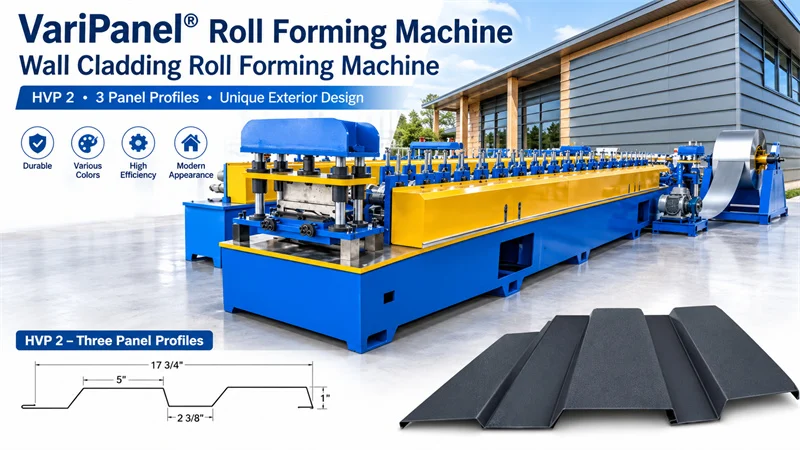

Modern architectural projects increasingly demand exterior wall systems that combine structural durability, weather resistance, installation efficiency, and attractive visual design. As a result, architectural metal cladding has become a popular solution for commercial buildings, industrial facilities, agricultural structures, public buildings, and contemporary residential projects.
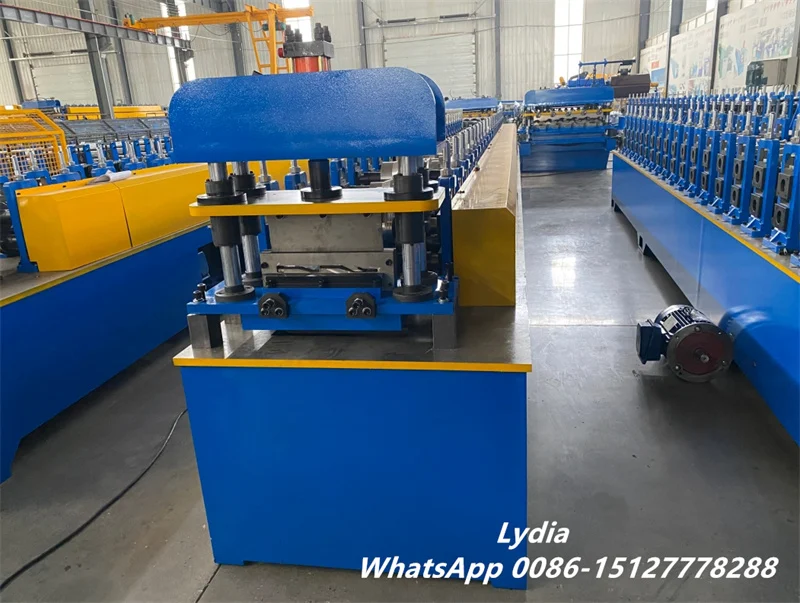
The VariPanel Roll Forming Machine manufactured by ZTRFM is designed to produce high-quality architectural metal wall panels with different rib widths and profile configurations. By using precision roll forming technology, this metal wall panel roll forming machine continuously transforms steel or aluminum coils into accurately shaped exterior wall cladding panels.
In particular, the machine can be configured to manufacture three VariPanel-style profiles: HVP 1, HVP 2, and HVP 4. Each profile features distinctive rib widths while maintaining consistent angled rib legs. Therefore, manufacturers can supply different panel designs for architects and contractors, creating attractive facades with alternating patterns, varied panel widths, and different color combinations.
Furthermore, ZTRFM provides customized production line configurations according to material specifications, panel dimensions, production requirements, and local electrical standards. With reliable mechanical construction and an imported-brand PLC control system, this Wall Cladding Roll Forming Machine offers an efficient solution for architectural metal panel manufacturing.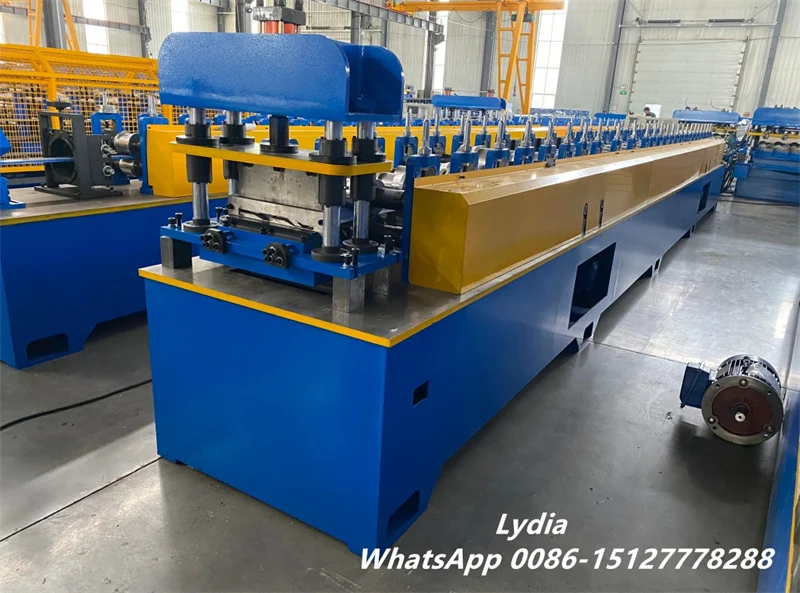
1. What Is a VariPanel Roll Forming Machine?
A VariPanel Roll Forming Machine is an industrial production line designed to manufacture architectural metal wall cladding panels with different decorative rib patterns. Unlike conventional wall panel machines that produce only one fixed profile, a VariPanel production system can be configured to manufacture multiple panel designs.
The HVP panel family includes three main profiles: HVP 1, HVP 2, and HVP 4. Although these profiles share similar angled rib geometries, their rib widths and overall visual effects are different. Consequently, manufacturers can combine several profiles to create distinctive exterior wall designs.
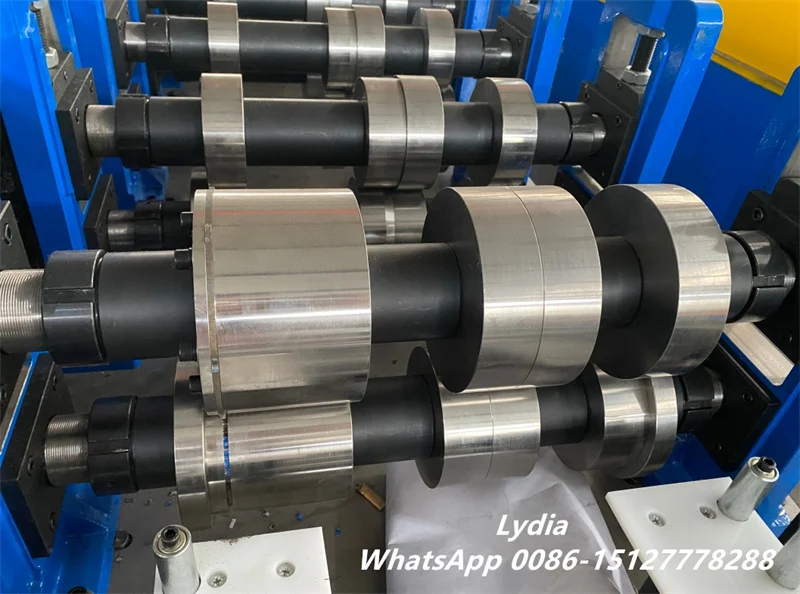
During production, metal coils pass through multiple precision forming stations. Each station gradually changes the flat metal strip into the required panel shape. This progressive forming process helps maintain consistent dimensions, smooth surfaces, and accurate rib geometry.
Moreover, the finished panels can be cut to customized lengths according to project requirements. Therefore, the metal wall cladding roll forming machine is suitable for both standard panel production and customized architectural orders.
2. HVP VariPanel Profiles and Section Design
The most important feature of the HVP VariPanel system is its three-profile configuration. Each panel has a different rib width, allowing designers to introduce visual depth and variation into large exterior wall surfaces.
All three profiles use angled rib legs. This geometry is particularly suitable for horizontal wall applications because the panel shape helps direct water away from the panel face and reduce water accumulation around the joints when properly installed.
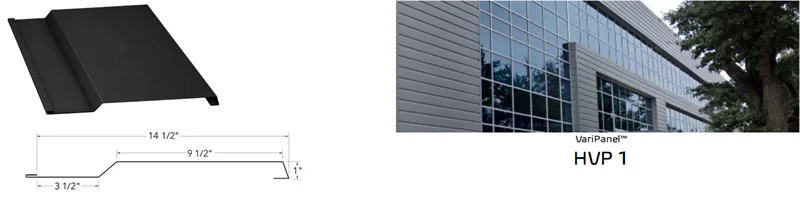
2.1 VariPanel HVP 1 – Narrow Rib Profile
VariPanel HVP 1 is the narrowest profile in the HVP family. Its relatively compact rib pattern creates a refined, closely spaced appearance across the exterior wall.
This profile is particularly suitable for commercial buildings, institutional facilities, architectural accent walls, and projects requiring a consistent, modern facade.
Because of its narrower visual pattern, HVP 1 creates more frequent shadow lines across the wall surface. Additionally, architects can combine different colors to produce decorative horizontal patterns without changing the overall building structure.
Main characteristics:
- Narrow rib appearance for a clean architectural finish.
- Suitable for modern commercial and industrial facades.
- Creates closely spaced shadow lines.
- Can be combined with HVP 2 and HVP 4 panels.
- Suitable for customized metal wall cladding projects.
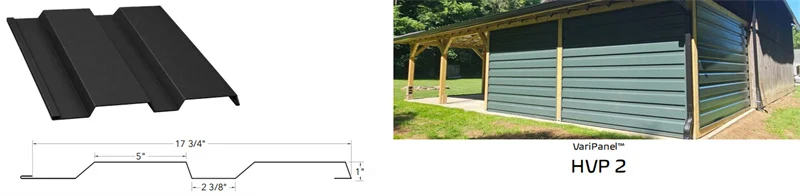
2.2 VariPanel HVP 2 – Wide Rib Profile
VariPanel HVP 2 is the widest panel in the HVP lineup, with a standard panel coverage width of approximately 17.75 inches.
Compared with HVP 1, the wider rib spacing creates a bolder architectural appearance. Furthermore, its wider coverage can reduce the number of panels required for a given wall area, potentially improving installation efficiency on large exterior projects.
The angled rib legs provide a distinctive three-dimensional appearance. As a result, light and shadows create visible depth across the building facade throughout the day.
HVP 2 is particularly suitable for large industrial buildings, agricultural structures, commercial facilities, and exterior wall systems where a bold horizontal design is preferred.
Main characteristics:
- Approximately 17.75-inch standard panel coverage.
- Wide rib spacing for a bold exterior appearance.
- Creates strong horizontal shadow lines.
- Suitable for large-format wall cladding applications.
- Can be installed together with HVP 1 and HVP 4 profiles.
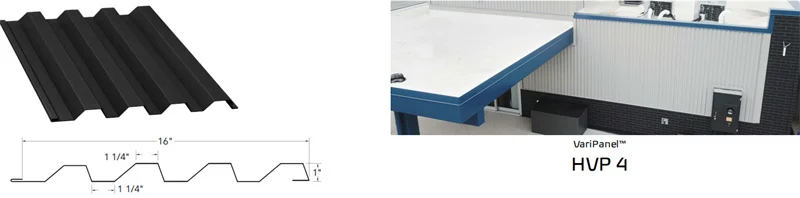
2.3 VariPanel HVP 4 – Medium Rib Profile
VariPanel HVP 4 provides a middle-width option between the narrower HVP 1 and wider HVP 2 profiles.
With a standard coverage width of approximately 16 inches, this profile creates a balanced appearance. Therefore, it is an excellent choice for architectural projects that require moderate rib spacing and a harmonious exterior design.
In addition, HVP 4 can be combined with the other two profiles to create gradual visual transitions. By alternating panel widths, designers can introduce different levels of depth and texture across a building facade.
Main characteristics:
- Approximately 16-inch standard panel coverage.
- Balanced rib spacing and visual proportions.
- Suitable for contemporary architectural facades.
- Creates attractive combinations with HVP 1 and HVP 2.
- Supports customized exterior wall designs.
2.4 HVP Profile Comparison Table
The following table summarizes the main differences between the three HVP panel profiles.
| Profile | Standard Coverage Width | Rib Design | Visual Appearance | Typical Applications |
|---|---|---|---|---|
| HVP 1 | 14.50 inches | Narrow rib | Fine and refined | Commercial and institutional facades |
| HVP 2 | 17.75 inches | Wide rib | Bold and dimensional | Industrial and large-format buildings |
| HVP 4 | 16 inches | Medium rib | Balanced and modern | Contemporary exterior wall systems |
Note: The above widths refer to the standard panel coverage dimensions supplied for the HVP profiles. Actual roll forming tooling and finished dimensions should be confirmed according to the customer’s approved profile drawings.
3. VariPanel Panel Section Drawings and Dimensions
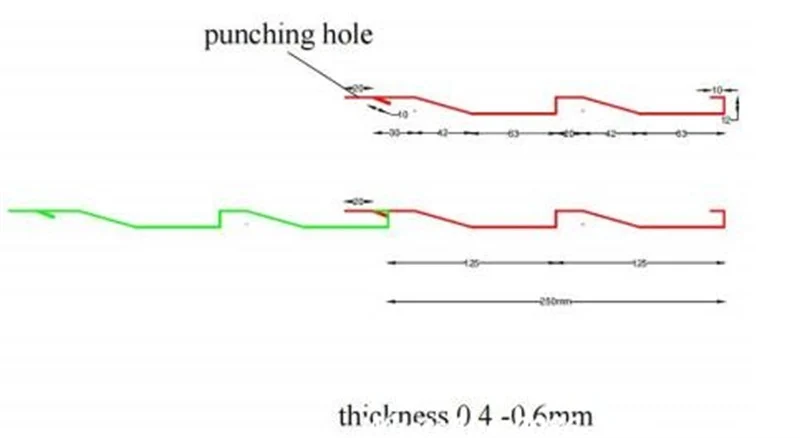
Profile drawings are essential when designing a VariPanel Roll Forming Machine. They determine the roller geometry, forming sequence, material width, and final panel dimensions.
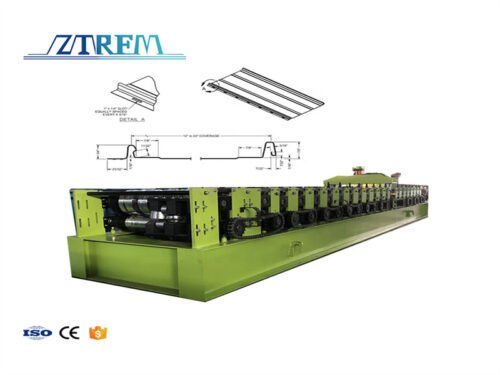
For the HVP 2 profile, the supplied reference drawing indicates an overall panel coverage width of approximately 17-3/4 inches. The drawing also identifies a 5-inch rib section, a 2-3/8-inch intermediate section, and a 1-inch profile height.
These dimensions provide an important starting point for designing the forming rollers. However, the complete profile drawing should also include the angled rib legs, edge details, material thickness, and any required connection or overlapping features.
HVP 2 Reference Profile Dimensions
| Dimension | Reference Size | Description |
|---|---|---|
| Overall coverage width | 17-3/4 inches | Finished panel coverage |
| Main rib section | 5 inches | Horizontal rib width |
| Intermediate section | 2-3/8 inches | Distance between profile sections |
| Profile height | 1 inch | Vertical rib height |
For HVP 1 and HVP 4, the roller tooling must be designed according to their respective approved section drawings. Although the three profiles share similar angled rib legs, the different rib widths require corresponding forming geometry.
Therefore, before manufacturing the machine, ZTRFM recommends confirming the following technical information:
- Complete cross-sectional drawings for HVP 1, HVP 2, and HVP 4.
- Finished panel coverage width and profile height.
- Steel or aluminum material specifications.
- Material thickness and mechanical properties.
- Panel edge and connection requirements.
- Required finished panel lengths.
4. Raw Materials and Production Specifications
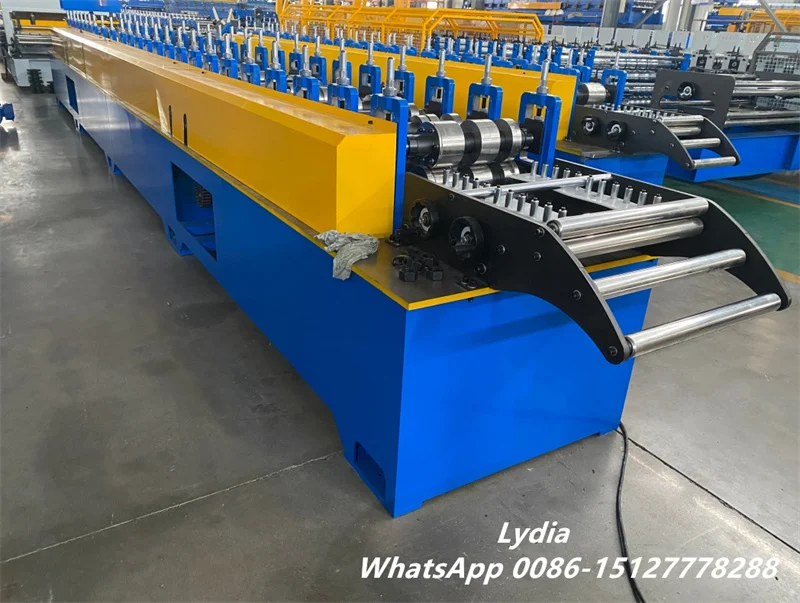
The Metal Wall Panel Roll Forming Machine is designed to process thin-gauge metal coils into architectural wall cladding profiles. Depending on the project requirements, the production line can be configured for galvanized steel, pre-painted steel, or aluminum coils.
For the supplied machine configuration, the recommended material thickness is 0.4–0.6 mm, with a maximum feeding width of 915 mm.
In addition, the HVP panel system supports several material options, including 24 GA and 22 GA steel, as well as .040-inch and .032-inch aluminum. The compatibility of each material with the selected machine configuration should be confirmed through engineering calculations and sample testing.
Typical Material Options
| Material | Available Specification | Typical Application |
|---|---|---|
| Galvanized steel | According to project requirements | Industrial exterior walls |
| Pre-painted steel | 24 GA / 22 GA | Decorative metal wall cladding |
| Aluminum | .040 inch / .032 inch | Architectural exterior facades |
Material selection directly affects the forming process, roller design, and finished panel performance. For example, different material thicknesses require appropriate roller clearances and forming pressure. Similarly, coated materials need smooth roller surfaces to minimize scratches during production.
As a result, ZTRFM can customize the roller tooling and machine parameters according to the actual coil specifications.
5. Working Process of the Metal Wall Cladding Roll Forming Machine
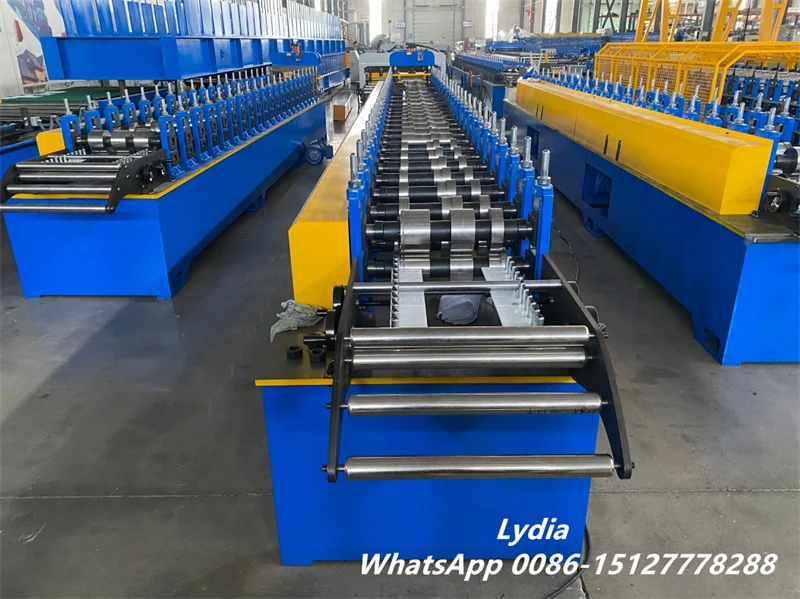
A complete Wall Cladding Roll Forming Machine production line converts metal coils into finished architectural wall panels through a continuous forming process. Each section performs a specific function to maintain production accuracy and efficiency.
Step 1: Coil Loading and Uncoiling
The production process begins with a metal coil loaded onto the uncoiler. The uncoiler supports the coil and releases the metal strip at a controlled speed. Consequently, the material can enter the forming section smoothly without unnecessary tension or deformation.
Step 2: Material Guiding and Feeding
Next, the metal strip passes through the guiding and feeding mechanism. This section aligns the material before it enters the roller stations. Accurate positioning is important because even small deviations can affect the finished panel width and rib symmetry.
Step 3: Progressive Roll Forming
The metal strip then passes through multiple precision roller stations. Each station gradually forms the flat sheet into the required HVP profile. Instead of creating the entire shape in one operation, progressive forming distributes the deformation across several stations.
This process helps produce consistent rib heights, smooth angled legs, and accurate panel dimensions. Furthermore, suitable roller materials and surface treatments improve tooling durability and production stability.
Step 4: Profile Inspection and Measurement
After roll forming, the finished profile can be inspected for dimensional accuracy. Operators can check panel coverage width, rib height, straightness, and surface condition. Therefore, dimensional inspection helps maintain consistent product quality throughout production.
Step 5: Automatic Cutting
Once the panel reaches the preset length, the cutting system separates it from the continuous material strip. The cutting method can be selected according to the machine configuration and customer requirements.
For projects involving different panel lengths, the PLC control system can manage preset cutting dimensions and production quantities.
Step 6: Finished Panel Collection
Finally, the finished wall panels are collected and stacked for packaging, transportation, or installation. An optional automatic stacking system can be integrated to reduce manual handling and improve production efficiency.
Overall, this continuous manufacturing process allows the Metal Wall Cladding Roll Forming Machine to deliver consistent panel quality while reducing unnecessary material handling.
6. Main Features of ZTRFM VariPanel Roll Forming Machine
6.1 High-Precision Roll Forming
The forming rollers are engineered according to the approved panel drawings. As a result, the machine can produce consistent rib dimensions and profile geometry. This is particularly important for architectural metal panels, where appearance and dimensional accuracy directly affect installation quality.
6.2 Multiple Panel Profile Solutions
The production line can be configured for HVP 1, HVP 2, and HVP 4 profiles. Depending on the selected tooling arrangement, manufacturers can produce different panel designs for various architectural applications.
For customers requiring frequent profile changes, ZTRFM can discuss interchangeable tooling or other customized changeover solutions according to the production requirements.
6.3 PLC Automatic Control System
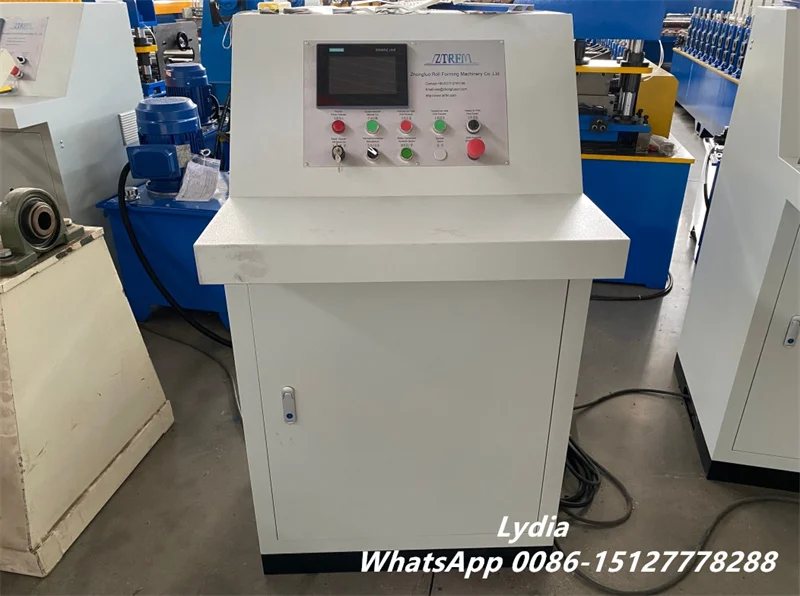
The machine uses an imported-brand PLC control system, with Delta specified for the supplied configuration. The control system coordinates feeding, forming, length measurement, and cutting operations.
Moreover, operators can set the required panel length and production quantity through the control interface. This reduces repetitive manual operations and supports more consistent production.
6.4 Heavy-Duty Machine Frame
The supplied configuration features a 350 mm H machine frame. Its structural design provides support for the forming stations and transmission components during continuous production.
A stable machine structure is important because it helps maintain roller alignment and reduces unwanted vibration during operation.
6.5 Customizable Machine Configuration
Different customers have different production requirements. Therefore, ZTRFM offers customized machine dimensions, colors, electrical configurations, and panel specifications.
Whether manufacturing standard horizontal wall panels or specialized architectural profiles, the production line can be engineered according to the customer’s approved drawings and material requirements.
7. Technical Specifications of VariPanel Roll Forming Machine
| Item | Technical Specification |
|---|---|
| Product Name | Metal Wall Panel Roll Forming Production Line |
| Machine Type | VariPanel Roll Forming Machine |
| Brand | ZTRFM |
| Feeding Width | 915 mm (36.02 inches) |
| Material Thickness | 0.4–0.6 mm |
| Machine Frame | 350 mm H |
| Control System | PLC Automatic Control |
| PLC Brand | Delta |
| Core Components | Motor, Electrical Components, PLC |
| Applicable Profiles | HVP 1, HVP 2, HVP 4 |
| Machine Weight | Approximately 10,000 kg |
| Machine Dimensions | Customized |
| Machine Color | Customized |
| Voltage | 380 V (Customizable) |
| Warranty | 1 Year |
| Video Inspection | Provided |
| Machinery Test Report | Provided |
| Place of Origin | Hebei, China |
| Export Port | Tianjin Port |
Note: The specifications above describe the supplied reference configuration. Production speed, number of roller stations, drive power, cutting method, and tooling arrangement can be finalized according to the approved technical proposal.
8. Architectural Applications of HVP Metal Wall Panels
Architectural metal wall cladding is widely used in modern construction because it combines lightweight construction with attractive exterior finishes. In addition, metal panels offer practical advantages in transportation, installation, and maintenance.
Industrial Buildings and Factories
Metal wall panels are commonly used on factory buildings, warehouses, and manufacturing facilities. Their horizontal rib patterns create a clean exterior appearance while providing a practical cladding solution for large building surfaces.
Agricultural Buildings and Equipment Shelters
Agricultural buildings, barns, equipment shelters, and storage structures can also use horizontal metal wall panels. Different HVP profiles and colors allow owners to coordinate exterior finishes with the surrounding environment.
Commercial and Retail Buildings
For commercial buildings, architectural appearance is an important part of brand identity. By combining HVP 1, HVP 2, and HVP 4 profiles, designers can create distinctive horizontal patterns and attractive facade details.
Modern Residential Projects
Metal siding is also suitable for contemporary residential exteriors, garages, and architectural accent walls. Its variety of colors and surface finishes provides flexibility for different building styles.
9. Frequently Asked Questions About VariPanel Roll Forming Machines
Q1: What profiles can a VariPanel Roll Forming Machine produce?
A VariPanel production line can be configured to manufacture HVP 1, HVP 2, and HVP 4 architectural wall panel profiles. Each profile has a different rib width and panel coverage dimension. The tooling configuration depends on the customer’s production requirements.
Q2: What is the standard width of HVP 1, HVP 2, and HVP 4 panels?
The reference standard coverage widths are 14.50 inches for HVP 1, 17.75 inches for HVP 2, and 16 inches for HVP 4. These dimensions should be confirmed against the final approved profile drawings before tooling production.
Q3: What materials can the metal wall panel machine process?
The machine can be configured for galvanized steel, pre-painted steel, and aluminum coils. The supplied reference configuration specifies a material thickness of 0.4–0.6 mm. Other material specifications require engineering confirmation.
Q4: Can the machine produce different panel lengths?
Yes. The PLC control system can be configured to manage preset cutting lengths. Finished panel lengths can be customized according to construction project requirements and the machine’s cutting configuration.
Q5: Are HVP metal panels suitable for horizontal installation?
Yes. The HVP VariPanel profiles are primarily designed for horizontal wall applications. Their angled rib geometry helps direct water away from the panel face when installed correctly with appropriate flashing and drainage details.
12. Get a Customized VariPanel Roll Forming Machine Solution
Are you planning to manufacture HVP architectural wall panels for commercial buildings, industrial facilities, or modern exterior cladding projects?
ZTRFM can provide a customized VariPanel Roll Forming Machine solution for HVP 1, HVP 2, and HVP 4 profiles. Whether you need a single-profile production line or a flexible multi-profile manufacturing solution, our engineering team can evaluate your drawings and recommend a suitable machine configuration.
Send us your profile drawings, material specifications, and production requirements. We will help you develop an efficient Metal Wall Panel Roll Forming Production Line for your business.


Reviews
There are no reviews yet.