
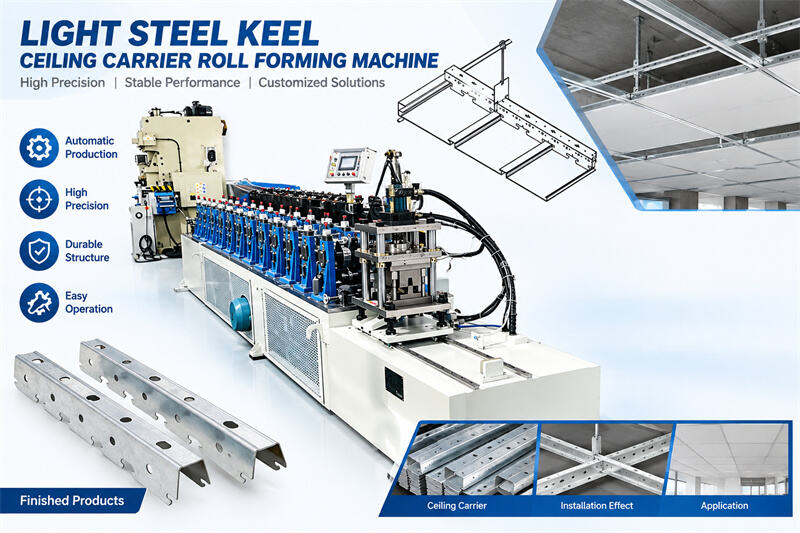
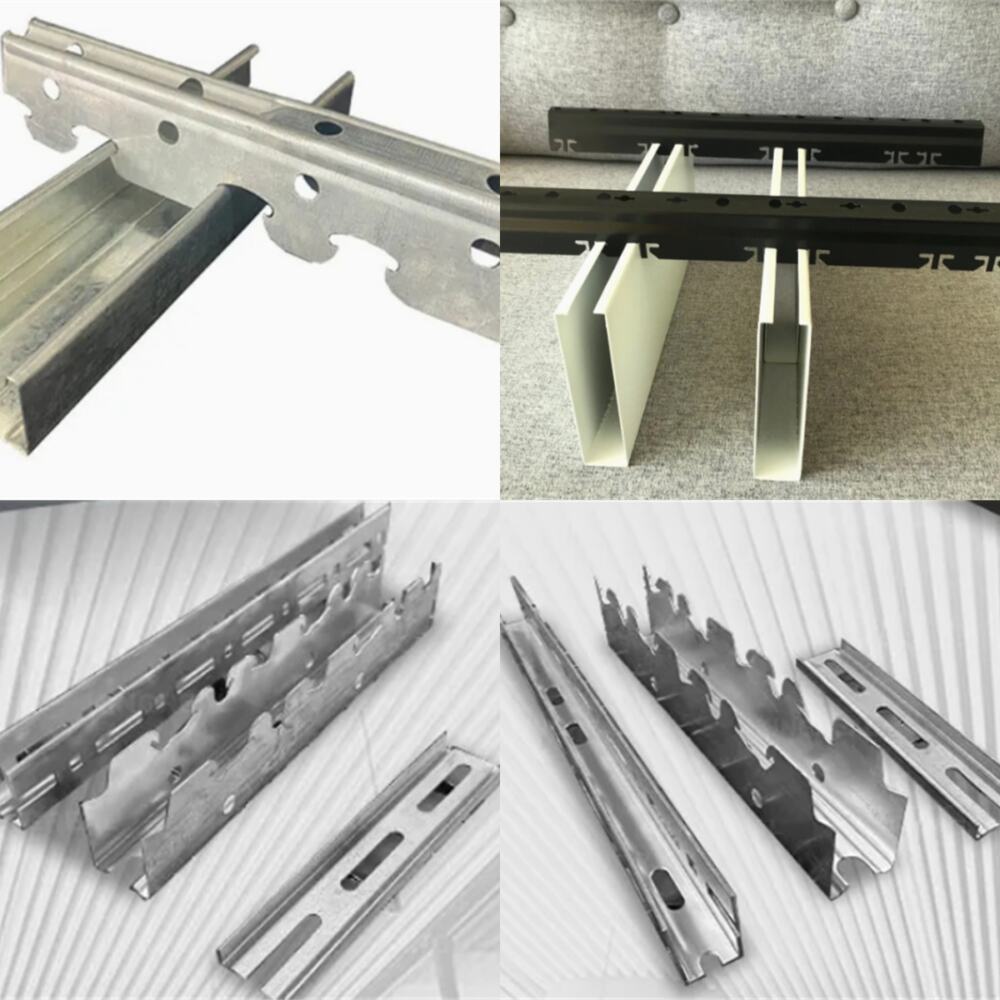

The Suspended Ceiling Cassette Keel Roll Forming Machine is a multi-specification production line developed for manufacturers serving commercial complexes, high-end residences, public buildings, and modern interior projects. The machine produces different types of ceiling carrier and keel profiles, including V-shaped, U-shaped, T-shaped, L-shaped, C-shaped, and other customized profiles, depending on the customer’s drawings and application requirement.
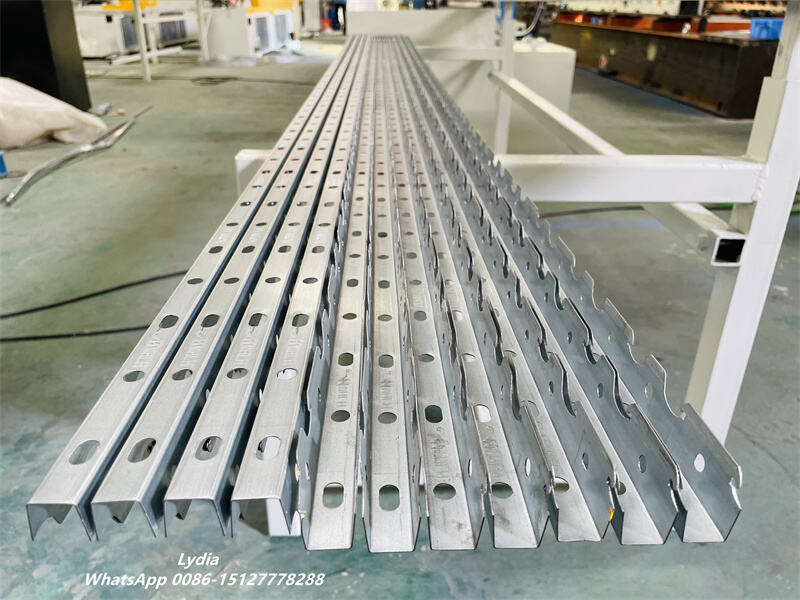
These profiles can work with plasterboard, aluminum panels, mineral wool boards, acoustic baffles, and other ceiling finishing materials. Therefore, the finished products are widely used in shopping malls, hotels, hospitals, office buildings, commercial facilities, industrial areas, and other architectural environments.
Modern ceiling systems often require different profile sizes and complex layouts. For this reason, Zhongtuo combines high-speed punching, NC servo feeding, precision roll forming, automatic length control, hydraulic cutting, and interchangeable cassette technology in one production line. The system can continuously process galvanized steel strips while maintaining stable punching and forming accuracy.
The machine is particularly suitable for manufacturers that need to produce several specifications without purchasing a complete roll forming line for every profile. With the cassette design, operators can change the forming tooling according to the required product and quickly resume production.
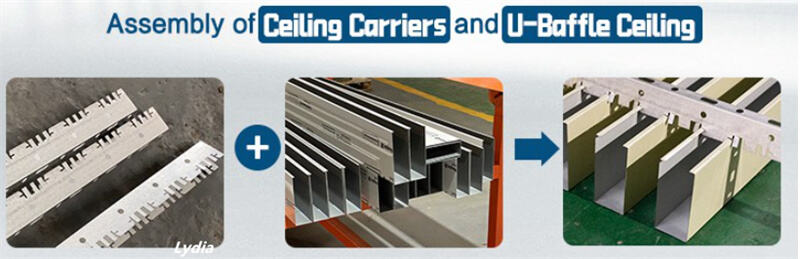
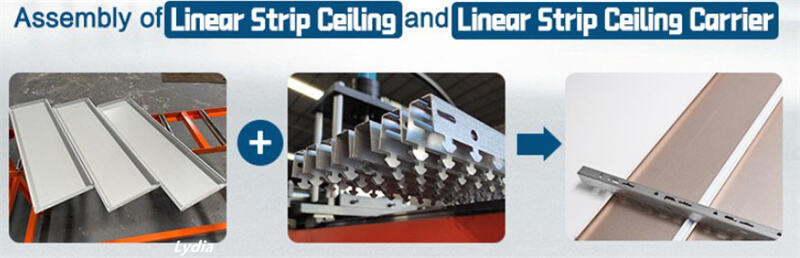
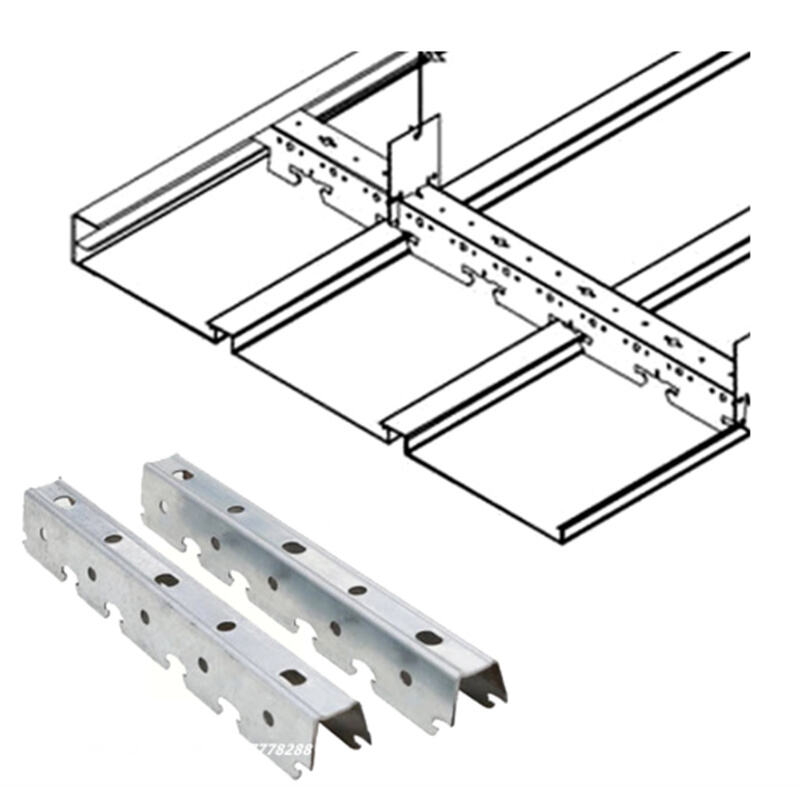
Flexible Cassette Design for Multi-Size Ceiling Profiles
The biggest advantage of the Cassette Type Roll Forming Machine is its ability to produce different profiles through interchangeable forming cassettes. Traditional roll forming machines normally use a fixed set of rollers for one profile. When the product changes, manufacturers may need another complete forming line or spend considerable time replacing and adjusting individual rollers.
Zhongtuo uses a different approach. The main machine provides the basic structure, transmission system, drive motor, and electrical control cabinet, while different forming profiles use corresponding changeable cassettes. Each cassette contains the roller shafts, forming roller stations, and supporting structure required for a specific profile.
When production needs to change, the operator can remove the existing cassette and install another one. After the cassette is properly positioned and fixed, the roller shafts can be connected with the transmission system, allowing the machine to start producing the new profile.
This configuration is especially suitable for manufacturers that have more product varieties but relatively lower production quantities for each individual specification. Instead of purchasing several complete machines, one basic forming line can accommodate multiple product requirements through additional cassettes.
With proper machine preparation, cassette replacement can be completed in less than one hour, depending on the cassette structure and operating conditions. An additional cassette generally costs around 40–50% of the cost of a complete gearbox-driven roll forming line, making the cassette solution a practical option for multi-profile production.
For projects requiring different profile widths, Zhongtuo can also design a movable roller-station structure. One side or both sides of the roller stands can be installed on linear guides and adjusted according to the programmed profile width. Once the required width is selected through the PLC program, the roller stations can move to the corresponding position, allowing the operator to change the production specification more efficiently.
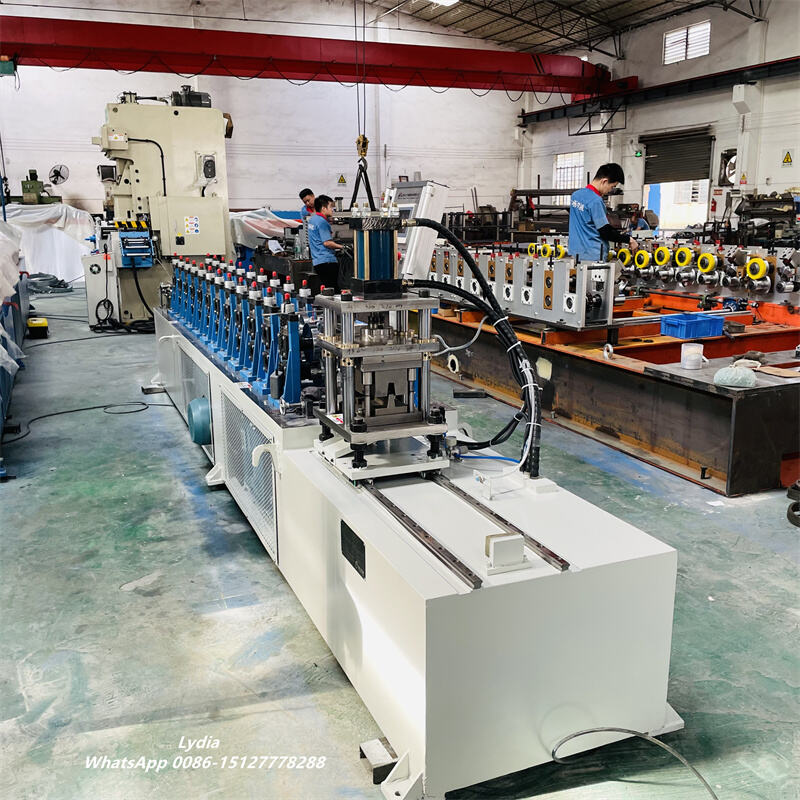
High-Speed Punching and Servo Feeding System
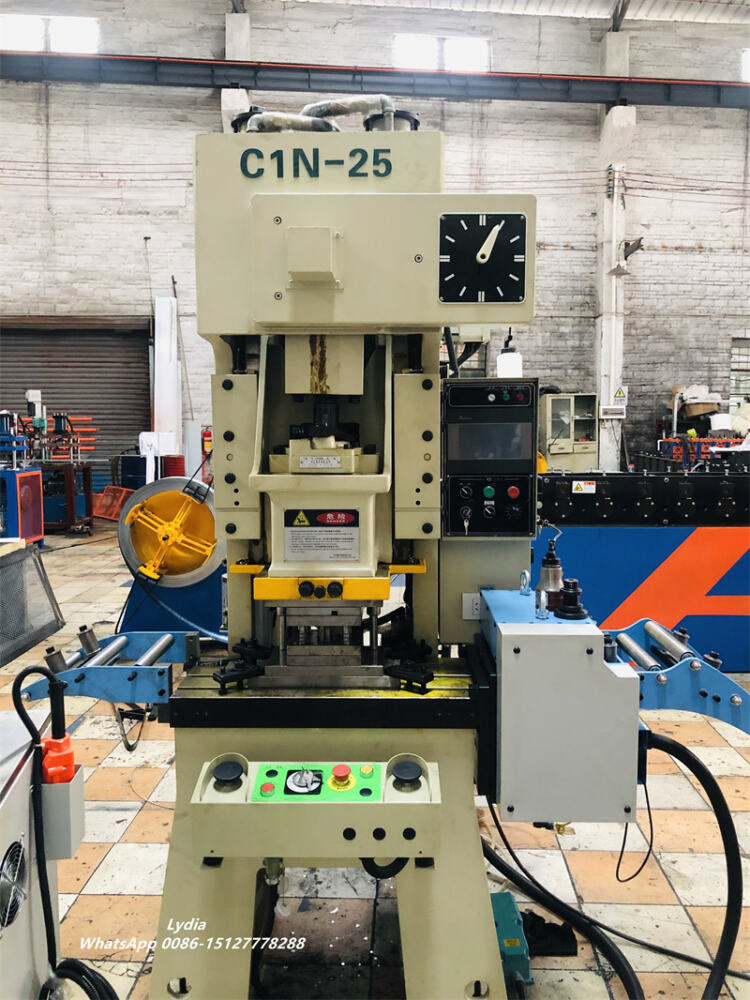
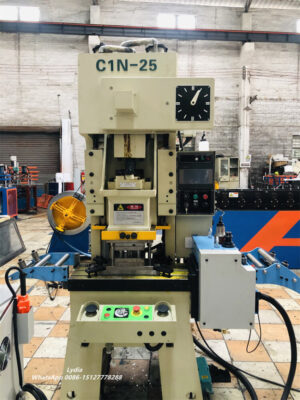
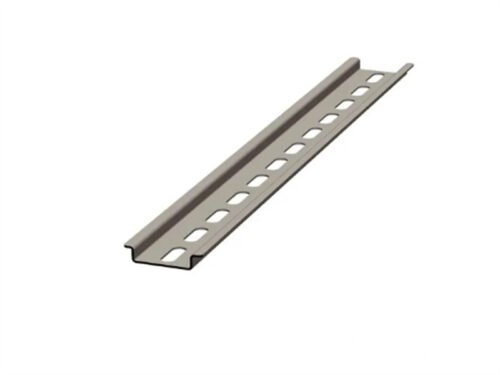
The suspended ceiling carrier production process normally requires precise holes or punching patterns before the strip enters the forming section. To achieve this, the Zhongtuo production line integrates an online punching system with the roll forming machine.
The line can use a high-speed punching press or hydraulic punching equipment according to the production requirements. The punching system creates holes directly in the continuously moving galvanized steel strip. After punching, the material enters the roll forming section for progressive cold bending.
This online configuration eliminates unnecessary intermediate handling and creates a continuous production process. At the same time, the high-speed punching system provides fast operation, stable performance, and accurate punching positions.
The NC roller servo feeder controls material movement between the decoiler, punching press, and forming machine. A 1.2 kW Yaskawa servo motor can be used for precise feeding control. The punching speed can reach approximately 100–200 strokes per minute, depending on the punching pattern, material, and production requirements.
The complete process can therefore coordinate uncoiling, leveling, servo feeding, high-speed punching, roll forming, length detection, hole counting, cutting, and unloading. This reduces manual intervention while helping manufacturers maintain consistent production quality.
Precision Roll Forming, Cutting and Production Specifications
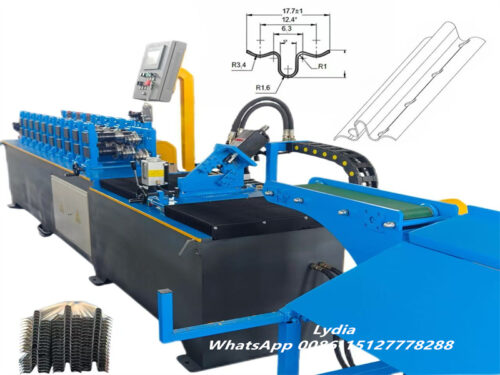
After punching, the galvanized steel strip enters the main roll forming section. The machine uses multiple forming stations to gradually bend the flat strip into the required V-shaped, U-shaped, or other customized cross-section.
The exact number of rollers depends on the profile geometry and customer’s drawing. A typical configuration includes approximately 10–15 roll forming stations. Zhongtuo designs the forming rollers according to the required dimensions so that the material passes through each forming stage smoothly and reaches the final profile accurately.
The machine can achieve a forming speed of approximately 5–20 m/min, depending on the required punching speed, profile design, material thickness, and production conditions.
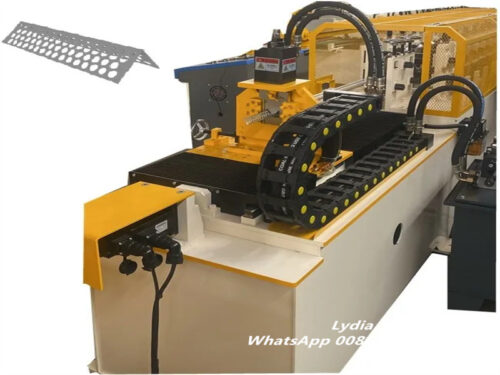
For length control, the system uses an encoder to detect the finished-product length. An optical fiber or related sensing system can also count the required holes. Once the programmed production length is reached, the hydraulic cutting system performs the shearing operation.
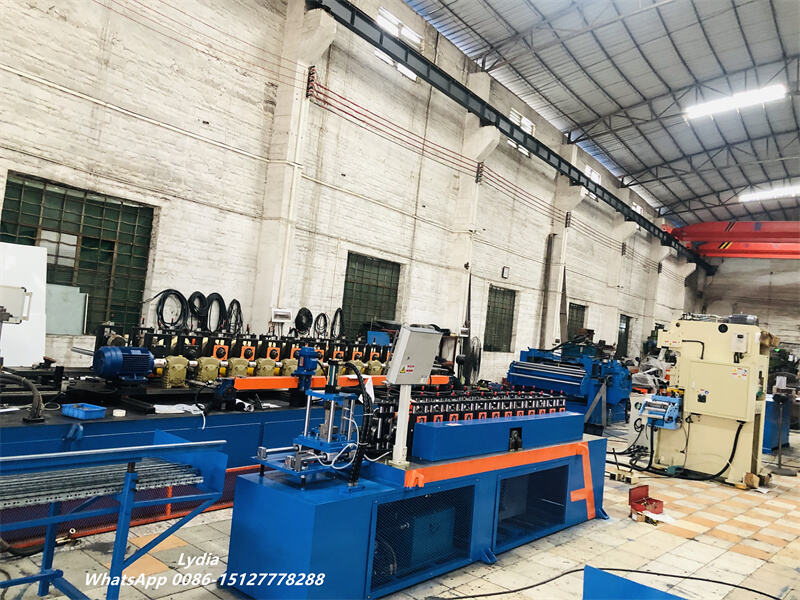
The line can use a high-precision pin-insert shearing method, in which the cutting process works together with the hole-position and length-control system. The hydraulic shear can also be equipped with an air cooling system to support stable operation during continuous production.
The following table summarizes the typical configuration of the suspended ceiling carrier production line:
| Item | Specification |
|---|---|
| Machine | Suspended Ceiling Cassette Keel Roll Forming Machine |
| Raw Material | Galvanized steel strip |
| Material Width | According to customer’s profile design |
| Carrier Shape | V shape or U shape, according to customer’s drawing |
| Other Profiles | T-shaped, L-shaped, C-shaped and customized profiles |
| Decoiler & Leveler | 2-in-1 decoiler and straightener |
| Maximum Coil Weight | 1 ton |
| Decoiler Type | Hydraulic expansion / manual loading options |
| Loading Option | Optional trolley for automatic metal loading |
| Punching Press | 25-ton capacity |
| Punching Speed | 100–200 SPM |
| Servo Feeder | NC roller servo feeder |
| Servo Motor | 1.2 kW Yaskawa servo motor |
| Maximum Forming Speed | 5–20 m/min |
| Roll Forming Stations | 10–15 stations, depending on profile |
| Machine Power | Approx. 20 kW |
| Length Detection | Encoder |
| Hole Counting | Optical fiber / sensor system |
| Shearing Method | Hydraulic pin-insert shearing |
| Cooling System | Air cooling system for hydraulic shearing |
| Forming System | Interchangeable cassette design |
| Profile Changeover | Quick cassette replacement |
Actual machine specifications can be adjusted according to the customer’s profile drawing, material width, material thickness, punching pattern, finished-product dimensions, and required production capacity.
2-in-1 Decoiler and Leveling System
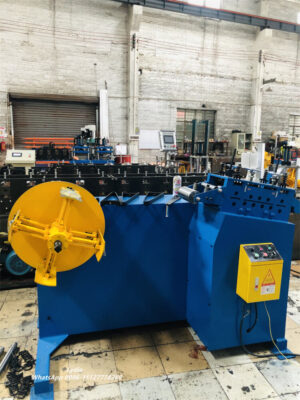
The production line starts with the 2-in-1 decoiler and leveling machine, which combines coil unwinding and strip straightening in one compact structure.
The decoiler supports the continuous unwinding of galvanized steel coil and can be configured with different loading methods. Depending on the customer’s requirements, Zhongtuo can provide a hydraulic decoiler or manual decoiler, while an optional trolley can assist with full or semi-automatic coil loading.
After unwinding, the strip passes through the straightening section. The leveling rollers remove deformation caused by coil storage and improve the flatness of the strip before it reaches the punching and forming sections.
A greater number of leveling rollers can help distribute the straightening force more evenly. As a result, the system provides more stable material feeding and supports the dimensional accuracy of the finished ceiling carrier.
This combined decoiler and straightener also helps save workshop space. Instead of installing separate machines for unwinding and leveling, manufacturers can integrate these two processes into one front-end unit.
Baffle Ceiling and Acoustic Ceiling Applications
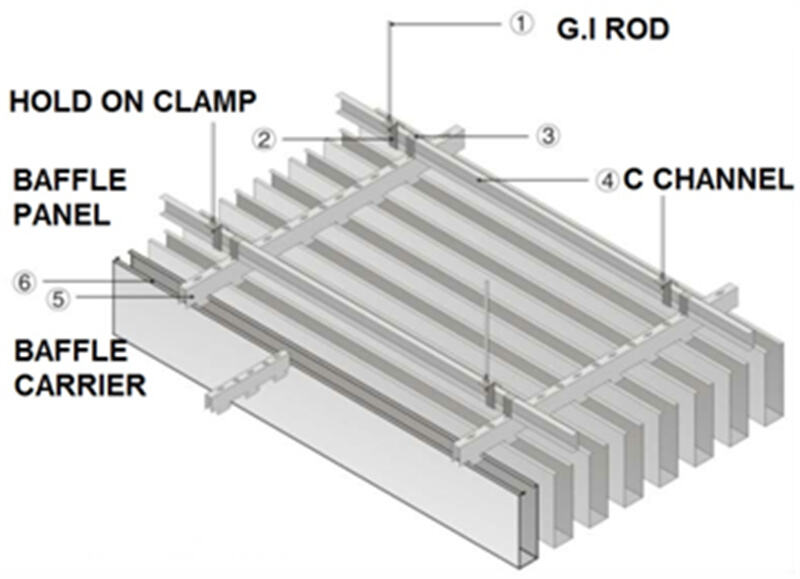
The finished carrier profiles are designed for use in a wide range of suspended ceiling and acoustic baffle ceiling systems. Baffle ceilings are particularly useful in commercial and industrial environments where controlling reverberation and reflected noise is important.
Hard interior surfaces can reflect sound and increase reverberation. Ceiling-mounted acoustic baffles provide an effective way to reduce these effects because both sides of the baffle can be exposed to the surrounding room. Depending on the building design, baffles can be installed vertically or horizontally from the ceiling.
These systems are commonly used in commercial buildings, offices, shopping malls, hotels, public facilities, industrial areas, and other spaces where acoustic performance and interior appearance need to work together.
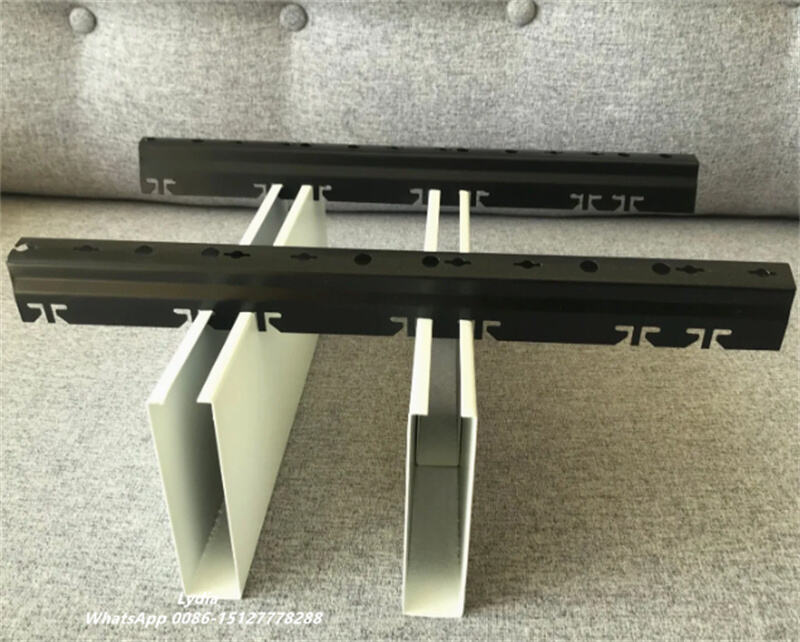
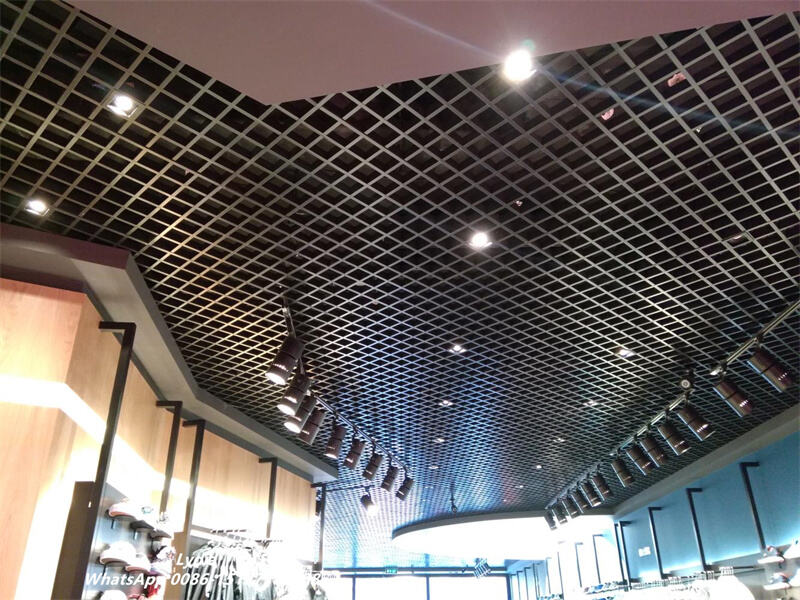
Baffle ceiling systems can achieve high NRC ratings when properly designed and combined with suitable acoustic materials. At the same time, their lightweight construction helps avoid adding unnecessary loads to the existing ceiling structure.
Depending on the project, baffles can be manufactured from galvanized iron or aluminum and supplied in different colors. Powder coating can be applied with a coating thickness of approximately 60 microns according to the customer’s requirements.
The carrier system manufactured by the roll forming machine provides the supporting structure for these suspended baffle systems. Zhongtuo can therefore design the forming tools around the customer’s actual baffle and hanging-system drawings.
Common baffle-related carrier dimensions can include:
40 × 60 mm, 40 × 75 mm, 50 × 25 mm, 50 × 50 mm, 50 × 75 mm, 50 × 100 mm, and 30 × 100 mm.
These dimensions are not limited to a fixed standard. Customized sizes can be developed when the customer provides a specific profile drawing.
Complete Production Line and Zhongtuo Solution
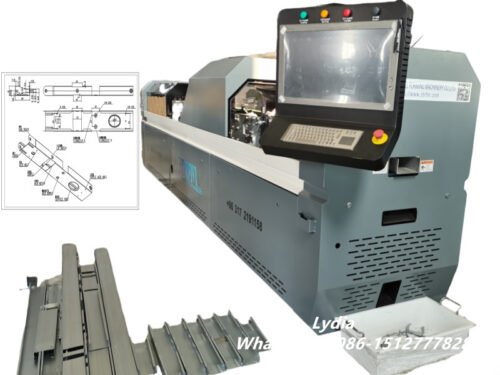
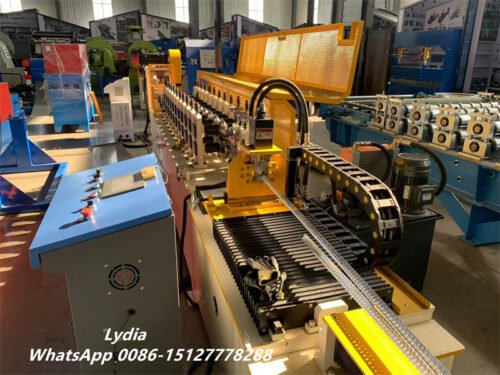
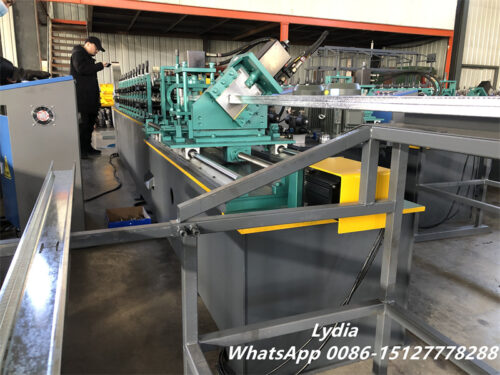
A complete Suspended Ceiling Cassette Keel Making Machine integrates several production processes into one coordinated system. The main components normally include the decoiler and straightener, high-speed punch press, NC servo roller feeder, main roll forming machine, automatic pin-insert shearing station, and output tables.
The production process starts when the galvanized steel strip is loaded onto the decoiler. The 2-in-1 unit then unwinds and straightens the strip before the servo feeder sends it into the punching section. The high-speed punch press creates the required holes, and the punched strip immediately enters the roll forming machine.
Next, the forming rollers progressively shape the strip into the specified ceiling carrier profile. The encoder monitors the production length, while the optical fiber or sensing system can monitor hole positions or hole counts. Finally, the hydraulic pin-insert shear cuts the profile to the programmed length before the finished products move to the output table.
Zhongtuo can also develop the forming rollers, punching molds, cassette structures, and production layout according to complex customer drawings. This is particularly useful when the project involves several profile specifications or special punching patterns.
The unique combi structure provides another important advantage. One production machine can support multiple product specifications by using different roller sets or forming cassettes. Operators can switch the required forming configuration instead of purchasing an independent complete line for every profile.
For manufacturers that need a flexible production platform, this structure can reduce equipment investment and workshop requirements while making future product expansion easier.
FAQ About Cassette Type Roll Forming Machines
What Is a Cassette Type Roll Forming Machine?
A Cassette Type Roll Forming Machine is a flexible cold roll forming system that uses interchangeable forming cassettes to manufacture different metal profiles. Instead of manually replacing every roller set when changing products, the operator can replace the corresponding cassette module designed for another profile.
Each cassette contains the forming rollers, roller shafts, and supporting station structure required for a particular product. The main machine can retain its basic drive and control system, making multi-profile production more practical and reducing the need for several complete roll forming machines.
How Does a Cassette Type Roll Forming Machine Work?
The machine first feeds the metal strip from the decoiler through the leveling and punching sections. After punching, the material enters the roller stations installed on the selected cassette. The rollers progressively bend the strip until it reaches the required cross-section.
When another profile is required, the operator changes the cassette and connects it with the machine’s transmission system. After installation and adjustment, the machine can begin forming the new profile.
This design allows one production line to manufacture several specifications while reducing equipment investment and workshop space requirements.
How Quickly Can the Forming Cassette Be Changed?
With the appropriate machine structure and operating conditions, the cassette can generally be changed in less than one hour. The actual changeover time depends on cassette weight, profile configuration, operator experience, and machine design.
The quick-change structure is especially useful for manufacturers that regularly switch between different ceiling carrier specifications.
Why Use a Cassette Roll Forming Machine for Suspended Ceiling Carriers?
Suspended ceiling and acoustic baffle projects often require different carrier dimensions and profile shapes. A cassette system allows manufacturers to accommodate these variations on one main production platform.
Therefore, it can be a cost-effective choice for manufacturers that need multiple profiles, flexible production, limited workshop space, and relatively moderate production quantities for individual specifications.
Instead of purchasing a separate complete machine for every profile, manufacturers can prepare different cassettes for different products and switch between them when production requirements change.
Can Zhongtuo Customize the Cassette Forming Machine?
Yes. Zhongtuo can design the roll forming system, cassette structure, punching tooling, feeding system, cutting system, and control configuration according to the customer’s profile drawings and production requirements.
The final configuration can be developed around the required material, profile dimensions, punching pattern, production speed, finished length, and number of products to be manufactured.
This allows the Suspended Ceiling Cassette Keel Roll Forming Machine to function as a flexible production solution for suspended ceiling carriers, acoustic baffle supports, and other customized light-gauge steel ceiling profiles.

Reviews
There are no reviews yet.