
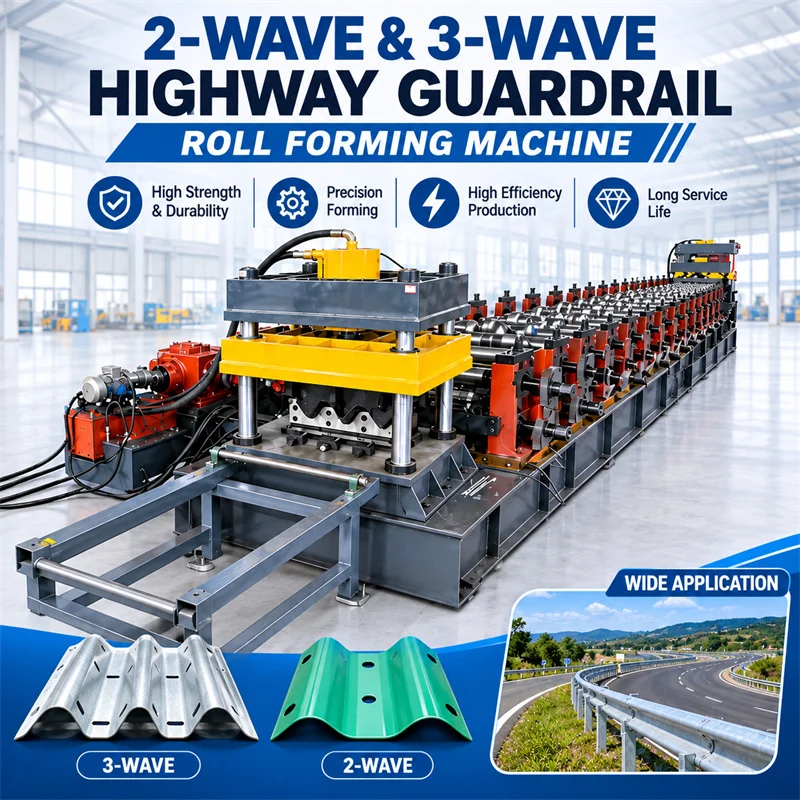
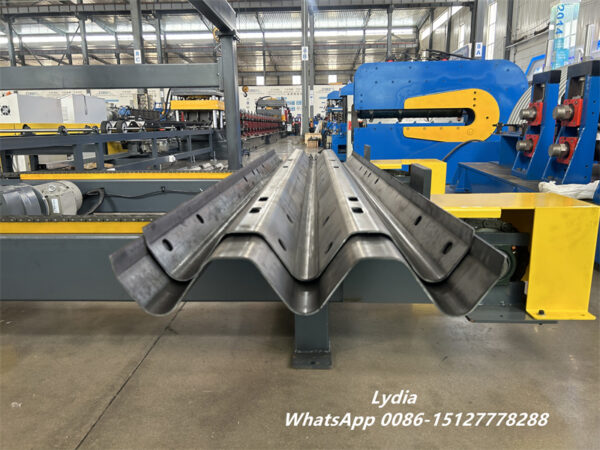
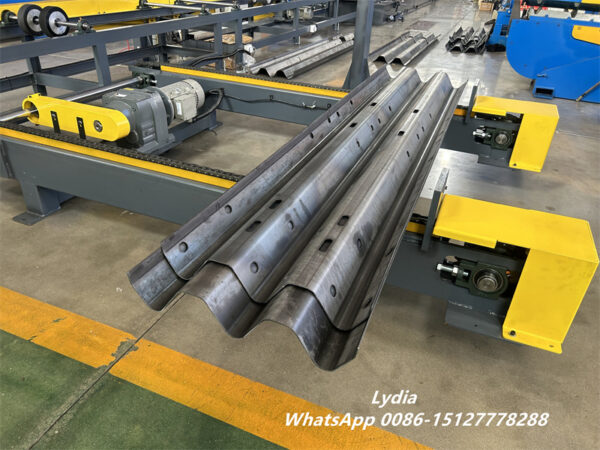
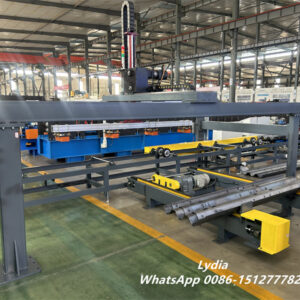
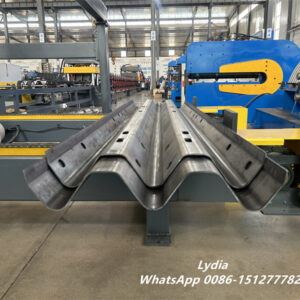
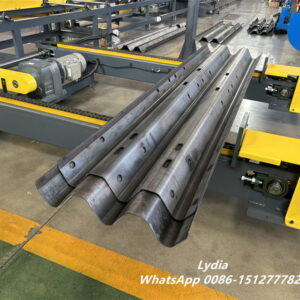

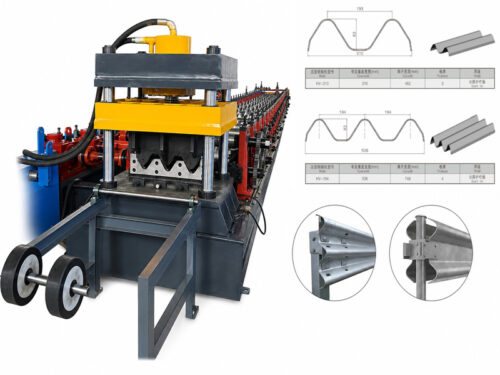
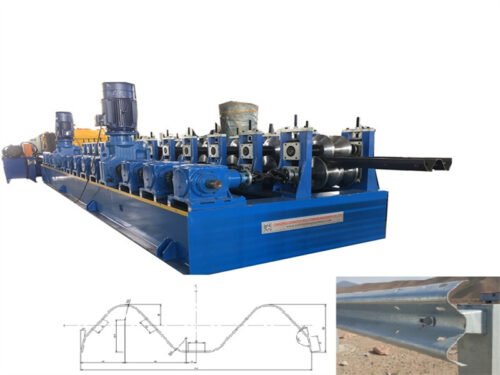
The Automatic Highway Guardrail Roll Forming Machine from ZTRFM is an industrial production solution designed to manufacture high-strength 2-wave W-beam crash barriers for highway safety infrastructure. It processes galvanized steel and hot-rolled structural steel coils into accurately shaped guardrail panels through leveling, hydraulic punching, continuous roll forming, cutting, and automatic stacking.
As highway construction projects demand reliable roadside protection systems, manufacturers need equipment that delivers consistent profile dimensions, strong structural performance, and efficient production. Therefore, this 2 Wave Guardrail Making Machine integrates heavy-duty mechanical structures, precision roll tooling, powerful hydraulic systems, and intelligent PLC control into one production line.
Moreover, the machine supports different steel grades and thickness specifications, allowing manufacturers to serve various highway barrier projects. With a gearbox-driven transmission system and Siemens electrical components, ZTRFM provides a dependable solution for continuous industrial guardrail manufacturing.
1. Applications and Production Capabilities
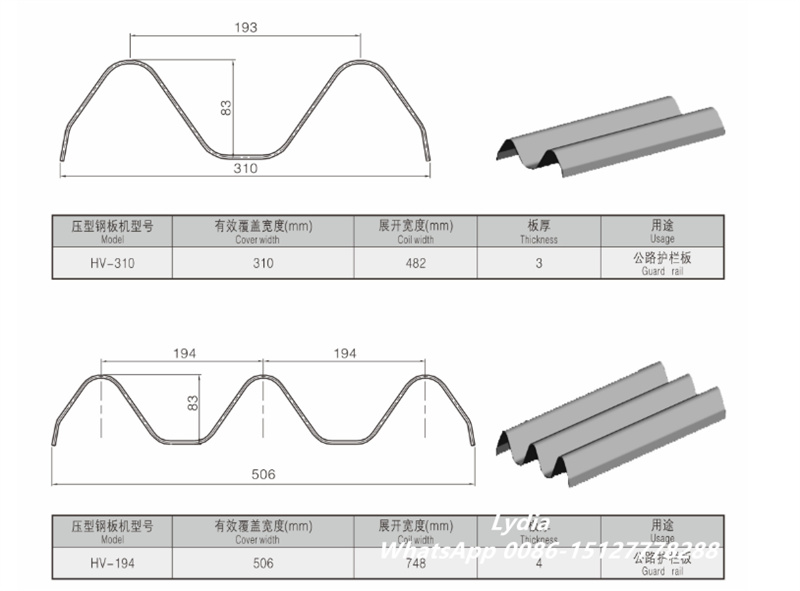
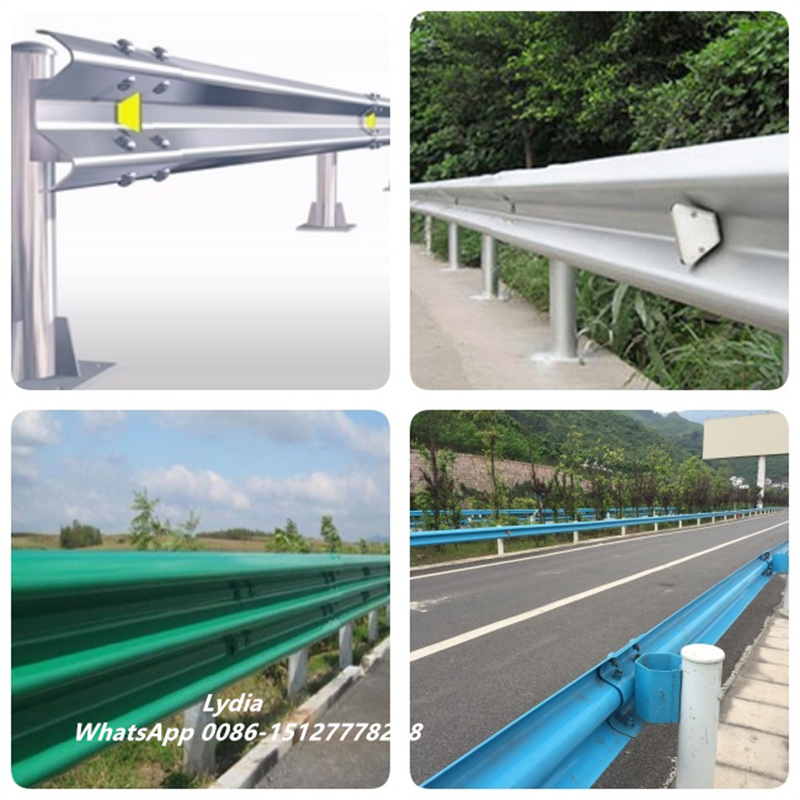
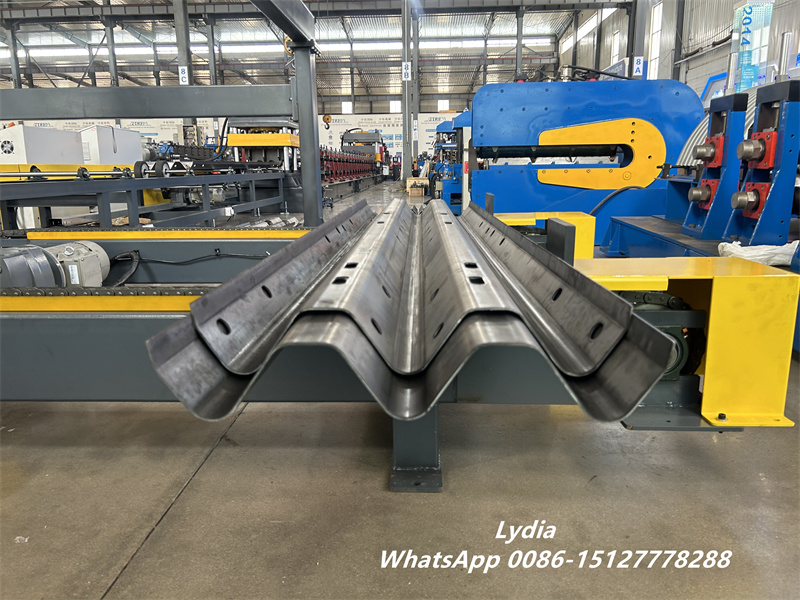
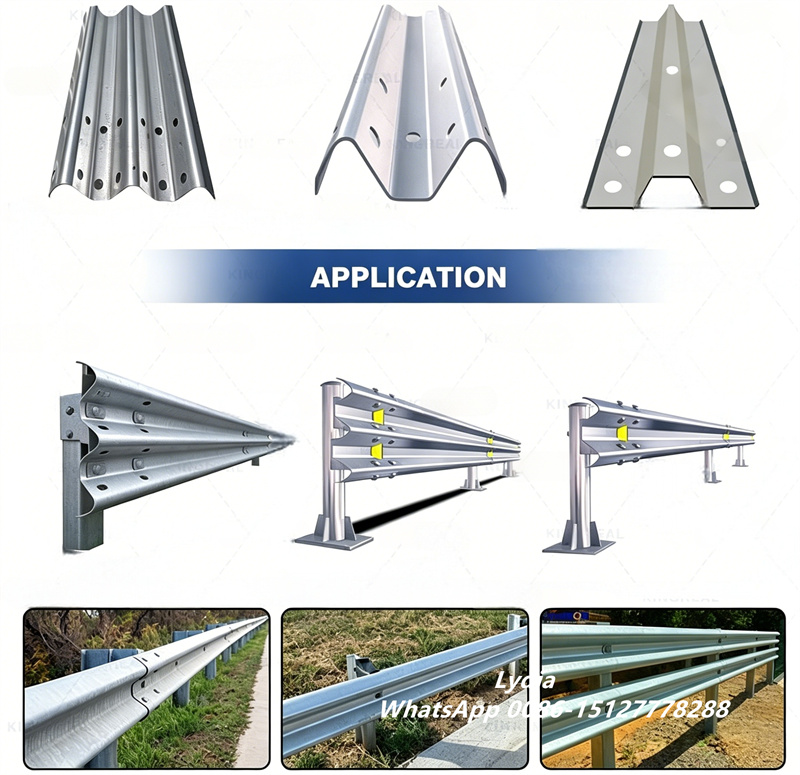
The W Beam Roll Forming Machine manufactures corrugated steel safety barriers commonly installed along highways, expressways, bridges, road shoulders, and other traffic infrastructure. Its two-wave profile helps absorb and distribute impact energy when vehicles collide with roadside barriers.
In addition to standard 2-wave W-beam panels, the production line can be configured with interchangeable tooling to manufacture compatible 3-wave guardrail profiles. This flexibility helps manufacturers expand their product range without investing in an entirely separate production system.
Depending on the project requirements, the machine can process hot-dip galvanized steel, pre-galvanized steel, and structural steel materials. Typical applications include highway crash barriers, roadside safety fences, bridge guardrails, and traffic protection systems.
2. Technical Specifications of the Guardrail Production Line
ZTRFM designs each Highway Crash Barrier Making Machine according to the required profile drawings, steel specifications, production capacity, and local highway standards. The following table presents the main configuration and reference technical parameters.
| Item | Technical Specifications |
|---|---|
| Product Type | 2-Wave Highway Guardrail / W-Beam |
| Forming Material | Galvanized Steel / HDG / GI / Q355B |
| Material Thickness | 3.0–4.0 mm (customizable) |
| Maximum Coil Width | 800 mm |
| Reference Feeding Width | 744 mm (profile dependent) |
| Forming Stations | Customized according to profile design |
| Roller Material | Cr12MoV, HRC 60–62 |
| Shaft Material | 40Cr |
| Shaft Diameter | 110 mm |
| Main Drive | Gearbox Transmission |
| Main Motor Power | 22 kW × 2 |
| Hydraulic Power | 45 kW punching station configuration |
| Cutting Method | Hydraulic Post Cutting |
| Control System | Siemens PLC and Electrical Components |
| Uncoiler Capacity | 10 Tons |
| Power Supply | 380V / 440V / 220V, customized |
| Machine Dimensions | Approx. 35,000 × 4,000 × 2,000 mm |
| Machine Weight | Approx. 45,000 kg |
| Certification | CE / BV / STV / ISO (configuration dependent) |
Note: Final dimensions, punching positions, profile tolerances, and production speed depend on the customer’s drawings and material specifications. Standard 2-wave guardrail dimensions can be configured to meet applicable AASHTO M180, EN 1317, or JT/T 281 project requirements. Actual compliance requires verification of the finished profile and the relevant crash-test and certification requirements.
3. Heavy-Duty Roll Forming, Hydraulic Punching and Cutting System
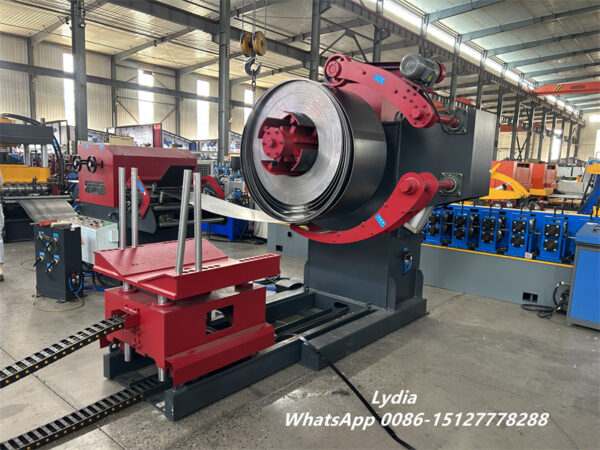
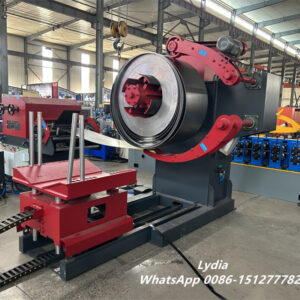
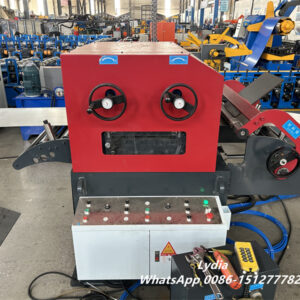
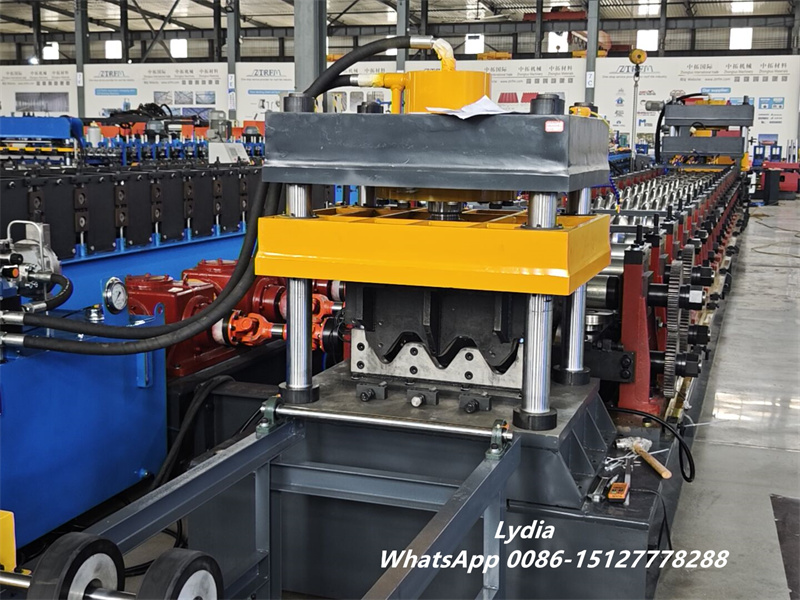
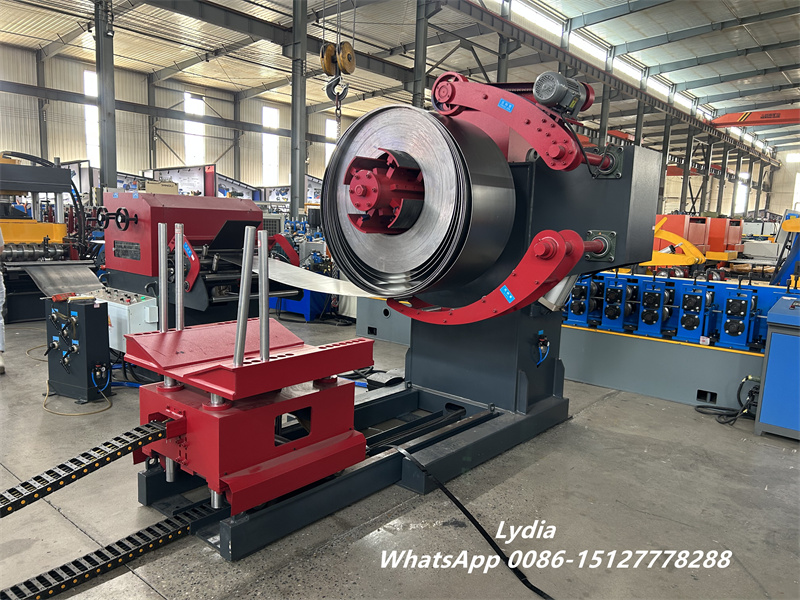
The production line starts with a 10-ton hydraulic expanding uncoiler. Its mandrel accommodates coil inner diameters of 508 mm and 610 mm, while the hydraulic expansion system securely holds the steel coil during feeding. Additionally, the electric drive provides stable material unwinding and reduces manual handling.
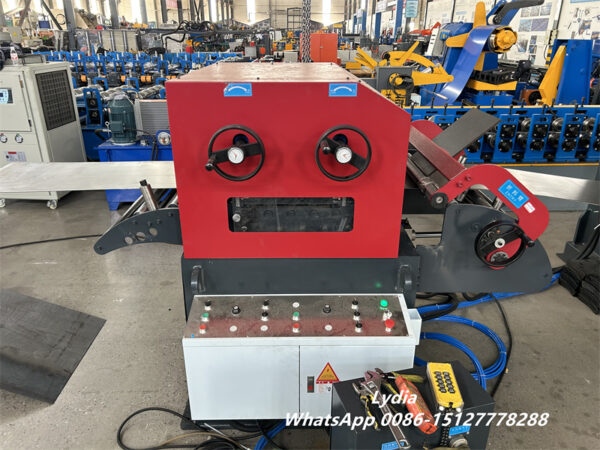
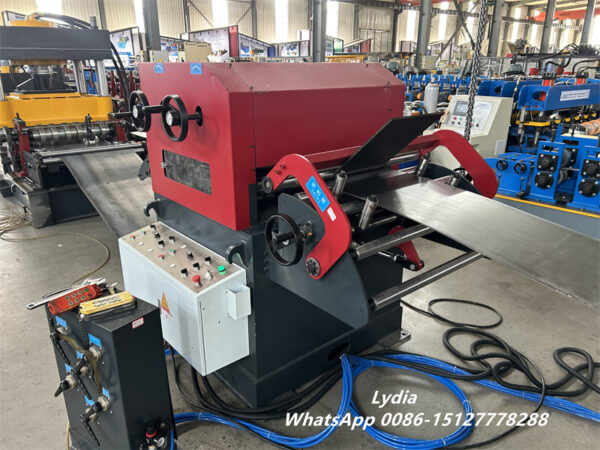
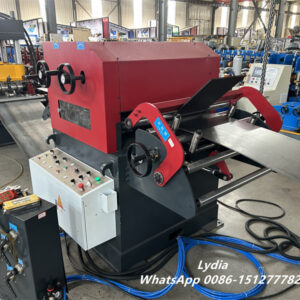
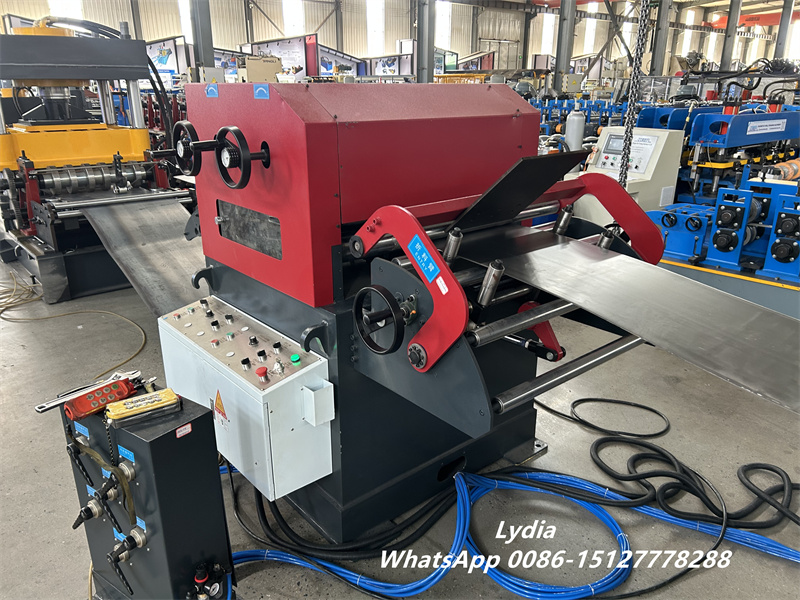
Next, the leveling and feeding unit removes coil deformation before the steel strip enters the forming section. It uses seven leveling rollers, arranged with three upper rollers and four lower rollers, together with two pinch rollers. The leveling rollers are manufactured from heat-treated 40Cr steel, reaching approximately HRC 48–52. Operators can manually adjust the roller gaps and feeding width to suit different materials.
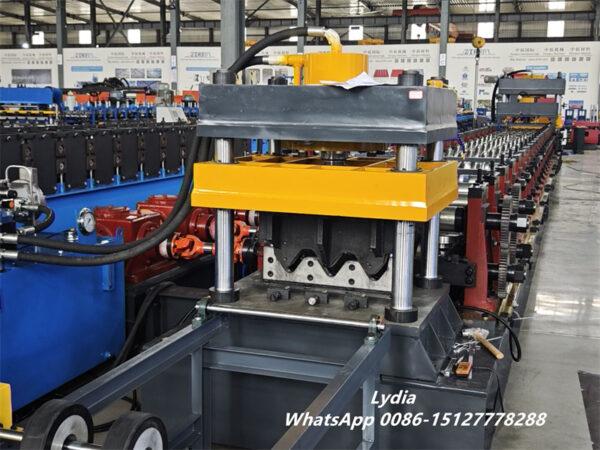
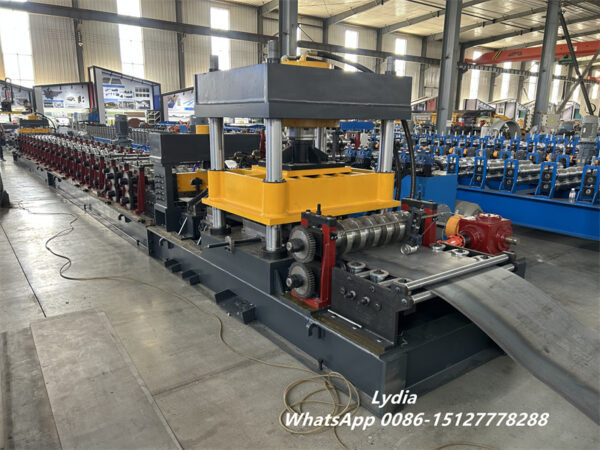
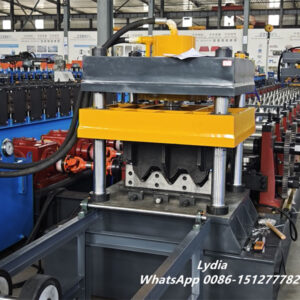
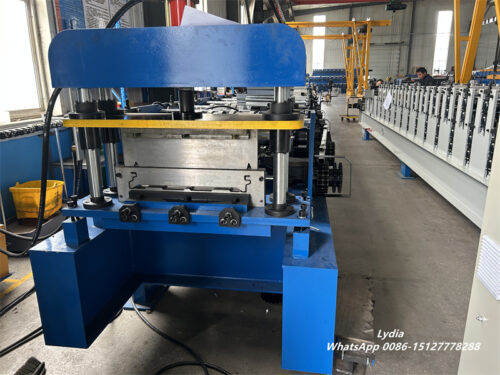
For accurate hole positioning, the Automatic Guardrail Production Line incorporates multiple hydraulic punching units. The main 300-ton punching system can process 18 slot holes simultaneously on compatible 2-wave and 3-wave profiles. Furthermore, a 60-ton hydraulic unit marks traceable serial numbers, while a 30-ton punching unit produces additional holes according to the profile design.
These punching operations prepare the guardrail panels for bolt connections and installation. The machine uses dedicated dies to maintain consistent hole positions and improve assembly efficiency. However, the final hole dimensions and spacing should follow the customer’s approved engineering drawings.
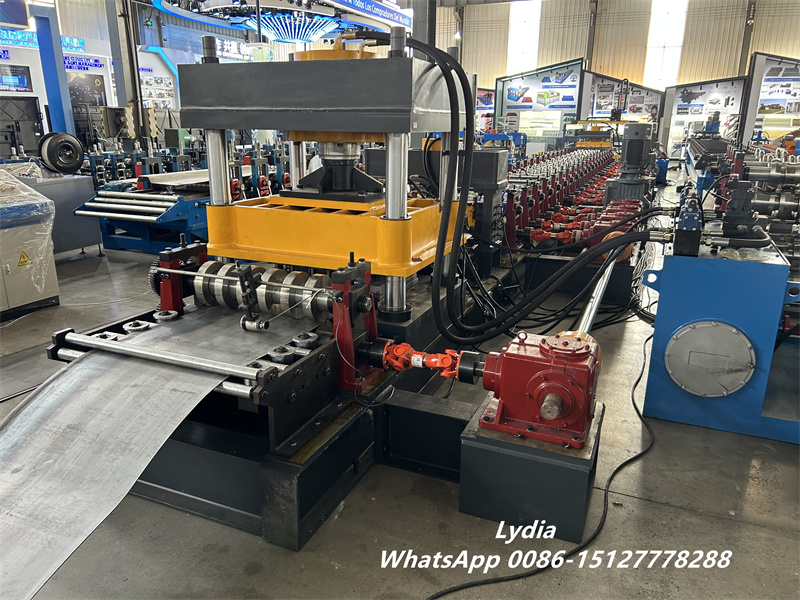
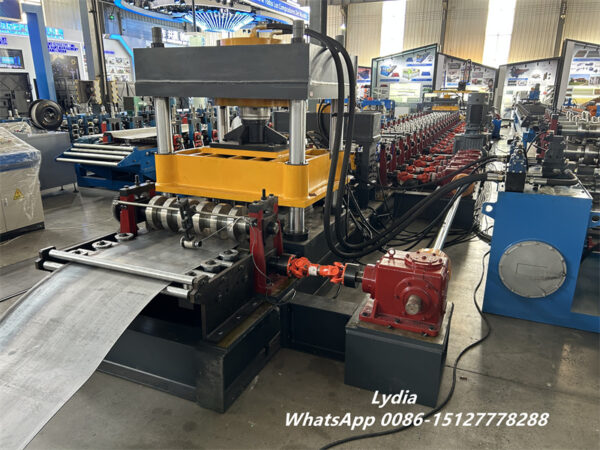
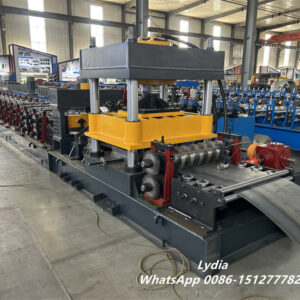
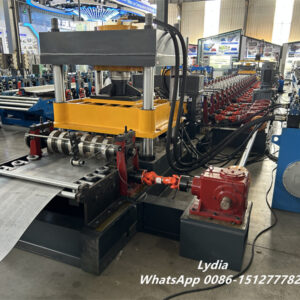
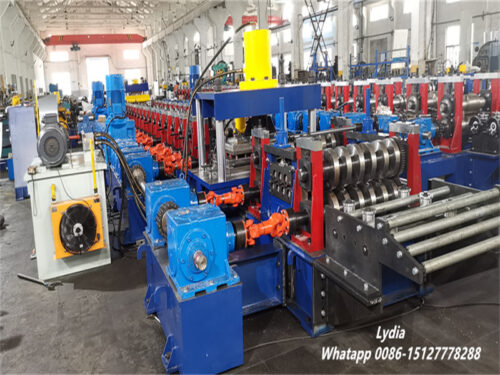
After punching, the steel strip enters the continuous roll forming section. Multiple forming passes gradually transform the flat steel into the required W-shaped cross-section. Rather than forcing the material into its final shape in one step, the progressive bending process helps control deformation and maintain consistent profile geometry.
The forming rollers use Cr12MoV tool steel with a hardness of HRC 60–62. Meanwhile, the 40Cr shafts provide the strength required for heavy-gauge steel processing. A cast iron arch structure supports the forming stands, and the gearbox transmission delivers stable torque to the roller shafts.
Finally, the hydraulic post-cutting system separates the finished guardrail panels according to the preset length. H13 cutting blades receive heat treatment to achieve a hardness of HRC 58–62. The machine can also use different cutting blade sets for 2-wave and 3-wave profiles when the corresponding tooling is included.
4. Siemens PLC Control and Automatic Stacking System
To simplify daily operation, ZTRFM equips the Highway Guardrail Roll Forming Machine with a Siemens PLC control system. Operators can enter production lengths, batch quantities, and other processing parameters through the touchscreen interface. The PLC coordinates material feeding, punching, roll forming, hydraulic cutting, and production counting.
At the same time, the hydraulic system uses industrial components, including Beijing Huade valves and a Yuken hydraulic pump. The punching hydraulic station is configured with a 45 kW Siemens Innomotics motor, providing the power required for heavy-duty punching operations. A separate hydraulic system operates the cutting equipment.
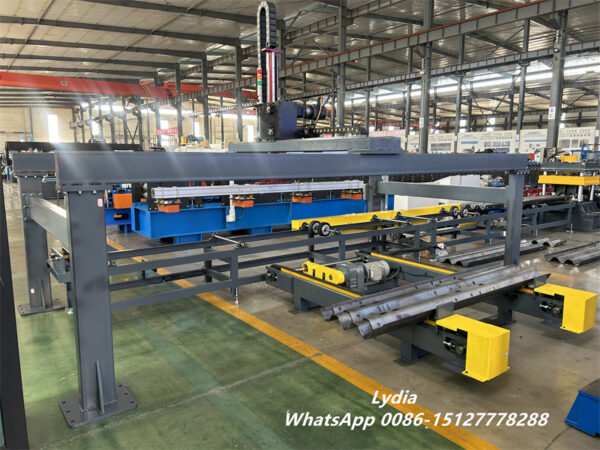
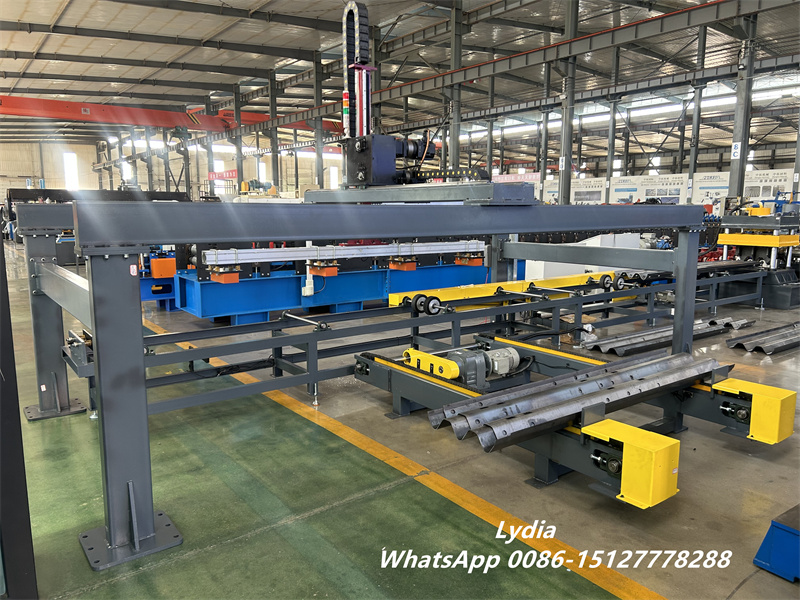
After cutting, the automatic stacking system collects the finished guardrail panels. Its welded square-tube frame supports movable rollers and a 4-meter stacking platform. A 3 kW servo motor controls vertical movement, while a 1.5 kW servo motor drives lateral movement. Hydraulic cylinders control the swinging discharge mechanism, helping transfer finished panels into organized batches.
As a result, the integrated stacking system reduces manual material handling and improves the overall workflow. Manufacturers can also configure the discharge arrangement according to their workshop layout and packaging requirements.
5. Why Choose ZTRFM Guardrail Manufacturing Equipment?
Heavy-duty guardrail production requires more than a conventional roll forming machine. It demands a coordinated system that can handle thick steel coils, maintain accurate punching positions, and produce uniform profiles throughout long production runs.
ZTRFM focuses on mechanical strength, processing accuracy, and practical automation. The heavy cast iron arch stands, 110 mm forming shafts, hardened Cr12MoV rollers, and gearbox-driven transmission provide a solid foundation for processing demanding steel materials.
Furthermore, the independent hydraulic punching and cutting systems allow the production line to complete several operations within one continuous manufacturing process. Siemens control components also make it easier for operators to manage production parameters and monitor machine operation.
As an experienced roll forming machinery manufacturer in China, ZTRFM provides customized machine design, production testing, installation guidance, and overseas engineer support. We can also adjust the roller tooling, punching dies, cutting blades, and stacking system to match specific customer requirements.
6. Frequently Asked Questions About the 2-Wave Guardrail Roll Forming Machine
Q1: What materials can this highway guardrail machine process?
The machine can process galvanized steel, hot-dip galvanized steel, pre-galvanized steel, and suitable structural steel materials such as Q235B and Q355B. The actual material thickness and yield strength should be confirmed before machine design.
Q2: Can one machine produce both 2-wave and 3-wave guardrails?
Yes. ZTRFM can design the production line with interchangeable forming rollers, punching dies, and cutting blades for both profile types. However, the tooling configuration and changeover requirements must be confirmed in advance.
Q3: What is the maximum steel thickness?
The reference configuration supports steel thicknesses of approximately 3.0–4.0 mm. For thicker or higher-strength materials, ZTRFM can evaluate the forming structure, drive power, roller dimensions, and hydraulic punching capacity before confirming the configuration.
Q4: Does the machine include hydraulic punching?
Yes. The production line can include a 300-ton main punching unit, a 60-ton marking unit, and a 30-ton auxiliary punching unit. These systems perform different punching and identification operations according to the guardrail design.
Q5: Can the guardrail production line automatically stack finished panels?
Yes. The automatic stacking system uses servo-controlled vertical and lateral movement, together with hydraulic discharge mechanisms. It helps organize finished guardrail panels and reduces manual handling during production.
Q6: Does ZTRFM provide installation and after-sales support?
Yes. ZTRFM provides technical support, machine installation guidance, commissioning services, and overseas engineer assistance. We also help customers confirm production drawings, machine configurations, and operating requirements before shipment.
Contact ZTRFM for a Customized Highway Guardrail Roll Forming Solution
Are you planning to manufacture 2-wave W-beam highway barriers or expand your existing guardrail production capacity? Send us your profile drawings, material thickness, steel grade, and required panel length. Our engineering team will recommend a suitable Automatic Highway Guardrail Roll Forming Machine configuration for your manufacturing project.
Reviews
There are no reviews yet.